When you invest ethically, what sits inside your portfolio matters.
One of the funds we use in our portfolios at Ethical Investing NZ is the BetaShares Global Sustainability Leaders Fund. It tracks the Nasdaq Future Global Sustainability Leaders Index, a global share index designed to include companies that meet defined environmental, social and governance (ESG) standards.
While this type of fund is often considered “passive,” the underlying index is anything but static. It is reviewed regularly to reflect changes in company behaviour, new data, and evolving ethical standards.
The most recent review, completed in May, resulted in a number of changes. Looking at these updates gives a valuable insight into how ethical investing works in practice, and the level of detail involved in maintaining a well-constructed portfolio.
What is an index?
An index is a curated list of companies selected based on specific criteria. It is designed to track the performance of a particular market or investment theme.
In this case, companies are selected based on ESG measures such as carbon efficiency, exposure to certain industries, and broader sustainability thresholds. The index is reviewed annually to ensure it continues to reflect current data and standards.
Companies added to the index
Several companies were included following the latest review:
- Eli Lilly and Adyen were added after achieving “carbon leader” status, indicating improved carbon efficiency within their industries.
- Aena was included after reducing its exposure to tobacco-related revenue below the index’s 5% threshold.
These additions show how companies can qualify for inclusion as their practices change and improve.
Increased exposure to decarbonisation
A clear theme in this rebalance is increased exposure to companies contributing to decarbonisation.
New additions include:
- Rivian Automotive, an electric vehicle manufacturer focused on trucks, SUVs and commercial delivery vans aimed at reducing transport emissions.
- EDP Renováveis, a global renewable energy company specialising in wind and solar generation.
- NextPower, a business focused on solar infrastructure and energy transition solutions.
These companies reflect growing exposure to renewable energy, clean infrastructure, and low-emissions technologies.
Companies removed from the index
At the same time, several companies were excluded after no longer meeting the index’s ESG criteria:
- Nokia was removed due to exposure to armaments and militarism above acceptable limits.
- Paycom Software no longer qualified as a “carbon leader” due to declining relative carbon efficiency.
- United Rentals was excluded after breaching fossil fuel service exposure thresholds.
Other removals were due to controversy concerns or companies falling below market capitalisation requirements.
What these changes show
This latest review highlights an ongoing process:
- Companies are included when they meet clearly defined ESG thresholds
- Companies are removed when they fall short
- The overall composition of the fund evolves over time
There is also a continued shift toward companies involved in clean energy and low-emissions technologies, alongside reduced exposure to businesses facing ESG risks.
Long-term performance
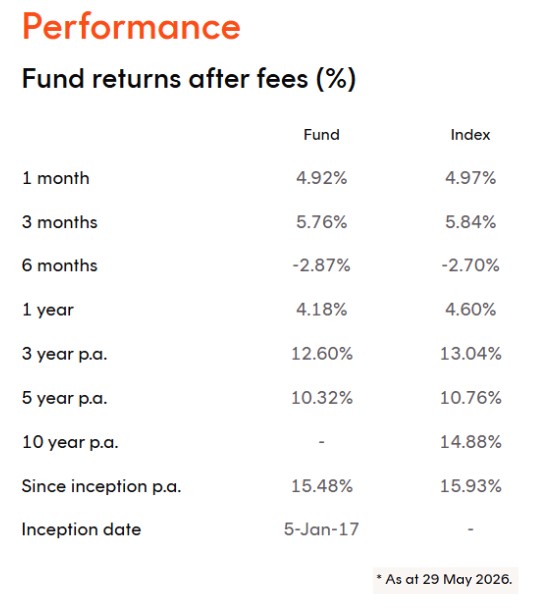
While we tend not to focus too much on short‑term fund performance, it’s always encouraging to see strong long-term results. This fund continues to deliver, with returns of 12.60% p.a. over 3 years and 10.32% p.a. over 5 years after fees, closely tracking its benchmark. It’s a great reminder of the value of staying invested in a well-constructed fund that not only aligns with your values but also delivers solid, consistent returns over time.